We moved to live on our narrowboat, The Puzzler, in April 2009, having sold our jigsaw and toy manufacturing business. We spent the first two years cruising around England, with two very cold winters on the Peak Forest canal, but in very good company.
In April 2011, The Puzzler was transported to Ireland, with several boating friends suggesting that we keep an online blog about our experiences, so that they could decide whether or not to go too! As a result, this record of our travels began.
In Ireland, we overwintered in Enniskillen in Northern Ireland, and during the summers, cruised practically all of the rivers and canals in both parts of this beautiful Emerald Isle.
This map shows where we went, during our three years in Ireland.
Moving on in April 2014, The Puzzler had a long road journey across Ireland to Dublin, then across the Irish Sea to Holyhead by ferry. Having crossed North Wales and England by road, it was on to the ferry again, to get to Holland, on the other side of the North Sea. We rejoined her at Warmond, near to Leiden, and set off to explore The Netherlands.
Again the map shows where we went in the next year, with our winter mooring being at Schagen, in North Holland. As there are so many small waterways in The Netherlands, I could not show them all, but have instead marked places which we reached with The Puzzler.
Once more it was April, in 2015, when we left Schagen to head south towards France. We took the short route across the east of Belgium, via Maastricht, and entered France on 2nd June.
This next map shows all of our travels in this wonderful country. There are no small cruising circuits in France, and all the waterways are huge, by British standards. We cruised practically all of these routes shown at least twice, and in some cases, more than that! We learned to keep out of the way of barges of up to 3000 tons and quite enjoyed their company on our travels.
The final map is of Belgium,with both our preliminary passage in 2015, from The Netherlands through into France, and our final journey in August 2018 to Nieuwpoort, on the coast of Flanders.
Here is a cruising summary for the ten years we have lived on The Puzzler. Although we used kilometres on the continent, I have converted them to miles, for a better comparison of distance travelled.
2009 728 locks + 1273 miles = 2001 lock/miles
2010 607 locks + 982 miles = 1589 lock/miles
2011 160 locks + 1093 miles = 1253 lock/miles
2012 231 locks + 831 miles = 1062 lock/miles
2013 212 locks + 838 miles = 1050 lock/miles
2014 119 locks + 1667 miles = 1786 lock/miles
2015 682 locks + 1555 miles = 2237 lock/miles
2016 878 locks + 1608 miles = 2487 lock/miles
2017 671 locks + 1098 miles = 1769 lock/miles
2018 578 locks + 1510 miles = 2088 lock/miles
In total 4866 locks + 12455 miles = 17321 lock/miles
So soon we will be back to living on dry land. The strangest thing we find about being in a house is that it does not move!
Many thanks for reading our blog and all the best for the future.
These are the adventures of Andy and Sally Rawnsley on their narrowboat "The Puzzler". We have been living on the boat for over nine years now and are still loving it. Our Ulster born Shih Tzu, Shannon, has grown up, and has taken over the boat! After three wonderful years in Ireland, we transported The Puzzler to The Netherlands, and spent a year there. In 2015 we went southwards, to reach the north of France by June. After glorious weather throughout the summer, we arrived in Roanne in late October, and enjoyed our winter in this friendly port. We cruised extensively in France in 2016, 2017 and 2018, returning to Roanne each winter.
Showing posts with label The Netherlands. Show all posts
Thursday, 11 October 2018
Saturday, 31 January 2015
20th - 31st Jan. Sam, Cees and Cheetah come to see us in Schagen. Visits to Petten and Den Helder.
We met Sam, Cees and Cheetah in September, and they have come to visit us by camper van in Schagen. It was good to see them again.
Last time we met was at Bourtagne, in the east of the Netherlands, in September.
Shannon is not so sure about Cheetah! She is a boxer / padenko cross and is a lovely dog.
We have come to see the work which is going on at Petten, on the coast. Nearly half of the Netherlands lies below the average level of the sea. With the climate changing and the sea level rising, there are several weak links in the chain of dykes which protect the Netherlands, and the sea wall at Petten is one such weak link. A new stretch of dunes and beaches 8 kilometres long and 250 metres wide is being created on the dyke's seaward side, a project requiring 38 million cubic metres of sand.
The sand is being sucked from the floor of the sea and thrown on to the new dunes by craft such as this. We can feel the power of it from where we stand on the current sea wall.
Further north it is possible to walk on the beach, but it is very cold today!
We continued by road to the north coast and the port of Den Helder. The dockyard there is very interesting. This dry dock is the oldest one in Holland, with an old sailing vessel in for repair.
Nearby is an old wooden minesweeper, which we think would have been used in World War 11.
Further on is the newer part of the harbour, with modern yachts resting for the winter.
Cheetah approves of Shannon's basket, although she does not quite fit!
The next day, when our visitors have gone, Shannon is pleased to have her bed back. It is just the right size for a shih-tzu!
Shannon is not so sure about Cheetah! She is a boxer / padenko cross and is a lovely dog.
We have come to see the work which is going on at Petten, on the coast. Nearly half of the Netherlands lies below the average level of the sea. With the climate changing and the sea level rising, there are several weak links in the chain of dykes which protect the Netherlands, and the sea wall at Petten is one such weak link. A new stretch of dunes and beaches 8 kilometres long and 250 metres wide is being created on the dyke's seaward side, a project requiring 38 million cubic metres of sand.
The sand is being sucked from the floor of the sea and thrown on to the new dunes by craft such as this. We can feel the power of it from where we stand on the current sea wall.
Further north it is possible to walk on the beach, but it is very cold today!
We continued by road to the north coast and the port of Den Helder. The dockyard there is very interesting. This dry dock is the oldest one in Holland, with an old sailing vessel in for repair.
Nearby is an old wooden minesweeper, which we think would have been used in World War 11.
Further on is the newer part of the harbour, with modern yachts resting for the winter.
Cheetah approves of Shannon's basket, although she does not quite fit!
The next day, when our visitors have gone, Shannon is pleased to have her bed back. It is just the right size for a shih-tzu!
Sunday, 28 September 2014
24th - 25th September. On along the new Veenvaart canal, including the Koning Willem Alexander Kanaal.
We moored in the Hondsrug Geopark on Wednesday. This dates back 135,00 years, but surely these stones were polished more recently!
Not far from the canal was this eerie place, with the remains of trees in the sunken area, which is now filled with water.
Carrying on along the Scholtens canal, which is part of the new Veenvaart waterway, the oak trees, with the smaller silver birch trees behind, look lovely.
Having turned on to the Koning Willem Alexander kanaal through Trambrug, we moored and walked on to see Koppelsluis. This is a staircase lock with two chambers.
Beyond the lock is a marked walk. The first part was alongside this horse gallop, where the sand is a remnant of the last ice age. A glacier came south through this part of The Netherlands 150,000 years ago.
Our return route is through tracks and woods. This has to be one of our best walks since arriving in Holland in April.
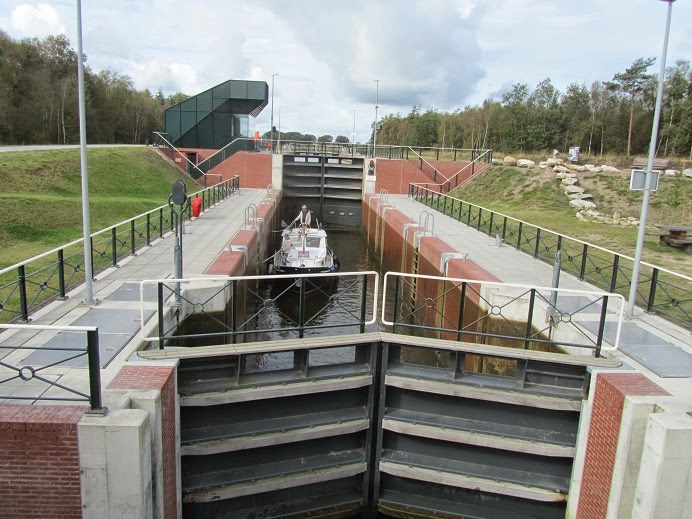
Back with The Puzzler, we are now on our way into the bottom lock at Koppelsluis.
Hold your boat securely as the paddles are raised!
There is a viewing platform on top of the control tower, for a good view of the lock. This lock takes us up to the summit level. We have now come up 15 locks (sluizen) and are 20 metres above sea level.
This giraffe was keeping an eye on things near to Spaarsluis.
Spaarsluis is another new lock, and has two side pounds in operation. These save a lot of water, when the lock is emptied, as half the water goes into these. This can then be used, next time the lock is filled up.
We moored below Oranjesluis, with two other boats. Oranjesluis is operated by remote control, possibly from Spaarsluis. As we approached the lock the lights went red and green, to say " I know you are there". The lock gates then opened for us and we were worked through, but not a person in sight. it is obviously very efficient, but still seems weird!
Sunday, 21 September 2014
17th - 19th September. De Blauwe Stad, and on to the German border.
Going on northwards, we crossed the Winschoterdiep and went on towards De Blauwe Stad. We moored near to a steam museum and walked to visit a nature reserve. To get there we decided to go by this self operating ferry, but it took innumerable winds to get it to our side. Luckily two cyclists appeared on the island and helped us to get the ferry across again.
Below the lookout tower, in the middle of the island, is an outdoor theatre, which would make a superb setting for a play.
Having decided not to wind the ferry again, it was a long walk to the nearest bridge, and was quite dark before we were back at The Puzzler. These shetland ponies and Shannon did not know what to make of each other!
Moving round to the harbour and visitor centre on Thursday, we found several intricate sand sculptures.
De Blauwe Stad was an exciting new development for the people of Groningen, and should have been a great success, with room for many properties on the islands. Sadly, not enough people wanted to come here to live, and it has not reached its full potential.
Going back to the main canal system, this imposing structure takes the motorway over our canal, and also over the railway to our left. Through our "tunnel" there are built-in fenders on the walls, to protect passing boats.
Travelling to the east, the Westerwoldse Aa canal is long and straight. I think my remark last time about interesting waterways was premature!
We sailed as far as Nieuwestans, which seems to be the most easterly town in The Netherlands. It is very industrial.
The next canal, going southwards, runs alongside the German Border. This time we have trees to offset the straightness! On this canal we have a special key so that we can work the bridges ourselves.
We paused by one bridge to have a look at Germany. It does not look very different here to The Netherlands.
At intervals along this canal there are still pillboxes to be seen, dating back to more troubled times along the border.
Below the lookout tower, in the middle of the island, is an outdoor theatre, which would make a superb setting for a play.
Having decided not to wind the ferry again, it was a long walk to the nearest bridge, and was quite dark before we were back at The Puzzler. These shetland ponies and Shannon did not know what to make of each other!
Moving round to the harbour and visitor centre on Thursday, we found several intricate sand sculptures.
De Blauwe Stad was an exciting new development for the people of Groningen, and should have been a great success, with room for many properties on the islands. Sadly, not enough people wanted to come here to live, and it has not reached its full potential.
Going back to the main canal system, this imposing structure takes the motorway over our canal, and also over the railway to our left. Through our "tunnel" there are built-in fenders on the walls, to protect passing boats.
Travelling to the east, the Westerwoldse Aa canal is long and straight. I think my remark last time about interesting waterways was premature!
We sailed as far as Nieuwestans, which seems to be the most easterly town in The Netherlands. It is very industrial.
The next canal, going southwards, runs alongside the German Border. This time we have trees to offset the straightness! On this canal we have a special key so that we can work the bridges ourselves.
We paused by one bridge to have a look at Germany. It does not look very different here to The Netherlands.
At intervals along this canal there are still pillboxes to be seen, dating back to more troubled times along the border.
Monday, 15 September 2014
8th - 12th September. Canal circuits around Groningen, as far as Appingedam, near the northeast coast of The Netherlands.
We are trying to see as many different waterways in Holland as possible in our time allowed, so we left Groningen going north, then west, on the Reitdiep canal.
We went as far as Elektra, before going southwards on Kommerzijlsterrijte, a much smaller canal, as far as the village of Neizijl, where our friends, Willem and Anke, joined us for a very pleasant evening. Although we were moored at least two kilometres from the Van Starkenborgh canal, we could still feel the water surging as the barges passed the end of our canal. When on the same canal as them, they seem to create little wash.
By Wednesday we were on the Van Starkenborgh canal, going back in the direction of Groningen. We were delayed by some work boats, as a big barge, Aloma, was coming towards us at the same time, and we had to wait for it to pass before we could continue. We saw few barges during our 8 km on this canal before going left on to Aduarderdiep, and then back for a brief visit to the Reitdiep, then the Winsumerdiep, to take us to Onderdendam, for the second time.
Thursday found us on Boterdiep, passing this pumping station, beside a zelfbedeining lock. In other words, we work it ourselves, by pushing the right buttons.
We carried on to the Westerwijtwerder-maar, another big name for a small canal. The villages along this canal are all very attractive.
Following Damsterdiep canal to Appingedam, we found the famous “hanging kitchens”, which were added to make more space, when former warehouses were converted into houses.
Appingedam is a pleasant town, which used to be a sea port, but has been replaced in this role by Delfzijl.
We have decided to miss the docks of Delfzijl, going to the south instead. We crossed the Eemskanaal, which is a major waterway, locking up about two metres, then down again on the other side, and on down Groeve canal to get to Schildmeer.
It was quite windy, and we were glad to find this sheltered canal bank, just south of the lake, at Sans Souci pumping station. Two cruisers turned up later on, planning to moor here, and were quite upset to find us in residence. They disappeared back to a mooring on the lake.
We went as far as Elektra, before going southwards on Kommerzijlsterrijte, a much smaller canal, as far as the village of Neizijl, where our friends, Willem and Anke, joined us for a very pleasant evening. Although we were moored at least two kilometres from the Van Starkenborgh canal, we could still feel the water surging as the barges passed the end of our canal. When on the same canal as them, they seem to create little wash.
By Wednesday we were on the Van Starkenborgh canal, going back in the direction of Groningen. We were delayed by some work boats, as a big barge, Aloma, was coming towards us at the same time, and we had to wait for it to pass before we could continue. We saw few barges during our 8 km on this canal before going left on to Aduarderdiep, and then back for a brief visit to the Reitdiep, then the Winsumerdiep, to take us to Onderdendam, for the second time.
Thursday found us on Boterdiep, passing this pumping station, beside a zelfbedeining lock. In other words, we work it ourselves, by pushing the right buttons.
We carried on to the Westerwijtwerder-maar, another big name for a small canal. The villages along this canal are all very attractive.
Following Damsterdiep canal to Appingedam, we found the famous “hanging kitchens”, which were added to make more space, when former warehouses were converted into houses.
Appingedam is a pleasant town, which used to be a sea port, but has been replaced in this role by Delfzijl.
We have decided to miss the docks of Delfzijl, going to the south instead. We crossed the Eemskanaal, which is a major waterway, locking up about two metres, then down again on the other side, and on down Groeve canal to get to Schildmeer.
It was quite windy, and we were glad to find this sheltered canal bank, just south of the lake, at Sans Souci pumping station. Two cruisers turned up later on, planning to moor here, and were quite upset to find us in residence. They disappeared back to a mooring on the lake.
Saturday, 6 September 2014
1st - 2nd September. Map of Holland. On to Borg Verhildersum, and the Seal creche at Pieterburen.
We are now in the province of Groningen, which is the most northerly part of The Netherlands. The orange dot shows where The Puzzler is.
We cruised on along on the Hunsingokanaal, before turning northwards. A small yacht was moored by a footbridge, and the crew called out to tell us to stop there, so we did. They had found a real gem of a place and felt we too should see it. This was Borg Verhildersum, a stately home set inside its own moat, surrounded by formal gardens.
We walked round all of these gardens, but could not visit the house as it was a Monday, when little opens in Holland.
The box hedges were wider than any we had ever seen, and everything was perfectly kept.
Continuing northwards, we joined the Pieterbuurster-maar, which was a big name for a very small canal!
We reached our destination at Pieterburen, of the Zeehondcreche, or seal sanctuary. There are nearly 100 young seals here at present, all at different stages of recovery. They will probably be here for about three months, until they are ready for release into the sea.
This net mountain has been made from fishing nets which have been removed from the necks or bodies of seals brought here to the sanctuary over the years.
The seals are all kept in small groups, once they are out of intensive care. This group has been here since June.
Time for a snooze!
Hanging in there!
This seal has eyes just like Shannon. He is very thoughtful.
All the seal handlers are most careful about hygiene, and wear special disposable clothing, which is discarded after each visit to any pen of seals. These seals are still being handfed with herring, until they learn how to feed themselves. Each seal needs about 5kg of fish every day
Pieterburen is as far as the canal goes. We squeezed past this cruiser to turn, and are now on our way back, scraping the bottom as we go.
This is certainly a twisty canal, and makes a nice change from canals like the Prinses Margriet!
We found a peaceful mooring, right out in the country, alongside a cycle track. Early next morning the school children cycled past us and shouted loudly to make sure that we were awake!
Subscribe to:
Posts (Atom)