These are the adventures of Andy and Sally Rawnsley on their narrowboat "The Puzzler". We have been living on the boat for over nine years now and are still loving it. Our Ulster born Shih Tzu, Shannon, has grown up, and has taken over the boat! After three wonderful years in Ireland, we transported The Puzzler to The Netherlands, and spent a year there. In 2015 we went southwards, to reach the north of France by June. After glorious weather throughout the summer, we arrived in Roanne in late October, and enjoyed our winter in this friendly port. We cruised extensively in France in 2016, 2017 and 2018, returning to Roanne each winter.
Showing posts with label Sancerre. Show all posts
Monday, 2 October 2017
18th - 30th September 2017. Along the Canal de Loing and the Canal de Briare, to join the Canal Latéral à la Loire. We harvest walnuts and sloes, but buy wine in Monetréol-sous-Sancerre.
To the south of Souppes the Canal de Loing has a very attractive section through the trees.
By lunchtime Sally is on the roof again, collecting some more walnuts.
The bottom gates at lock 35 have been damaged by a peniche, which must have come up underneath the walkway. It was lucky that he did not lift the gates too!
The approach to Montargis reminded us of Utrecht, in The Netherlands. We are now on the Canal de Briare.
At last we have found some sloes! Andy is going to patent our “sloe pricker”, which makes the job much quicker than by using the forks.
Shannon has spotted a cat in a tree by a lock.
We had to wait over lunchtime at Rogny-les-Sept-Ecluses. The mooring on the other side was a bad height for us, but this side was shallow, so the plank did a good job. The swans were very hungry.
These are the original seven locks of Rogny, while the new flight of six, starting to the right here, each rise over 4 metres.
We had a proper walk round Briare this time. We were here two years ago, but did not stay here then. The church of St. Etienne is lovely.
The rose window, situated behind the organ, is very unusual in that it shows all the signs of the zodiac.
We are leaving the Canal de Briare as we cross the aqueduct to join the Canal Latéral à la Loire.
The river Loire is far below the canal here. We will travel near to the Loire all the way to Roanne.
Forty kilometres further on, we find vines again, near to Sancerre.
Monétréol-sous-Sancerre is an old village in the heart of the vineyards, with wine 'caves' to see. Both the ones we visited were based in farmyards, but we preferred the wine tasting room of Lepresle, which was a basic outbuilding of the farm. His wine tasted better too!
Looking back towards Monétréol, the hill town of Sancerre can be seen above it. We visited Sancerre in early September two years ago, and really enjoyed it.
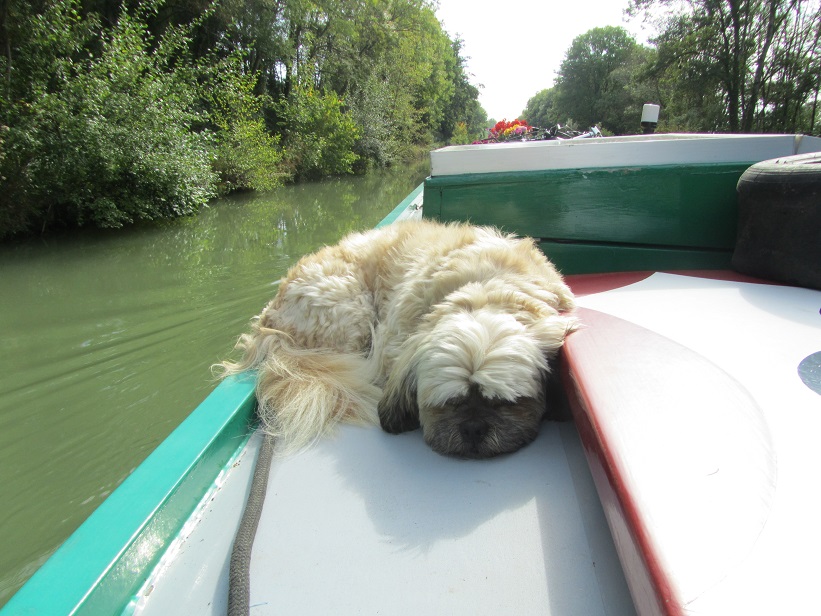
Someone needs a haircut!
By the weekend the sun was hot enough for sunbathing, although the mooring was a little rural.
Wednesday, 16 September 2015
8th - 11th September. A visit to Ménétréol-sous-Sancerre, then up through the vineyards to Sancerre. On to the Briare Aqueduct and the end of the Canal Latéral à la Loire.
The village of Ménétréol-sous-Sancerre, seen ahead of us, is aptly named, as the town of Sancerre is situated on the top of the hill above the village. Sancerre is one of the famous wine-growing regions of France.
We moored in Ménétréol-sous-Sancerre, which has several “caves” where we could taste and buy Sancerre wine. We chose a white wine, which had been grown on a chalk soil.
Further into the village, some houses date back to the 16th and 17th century. It is a place with great character. The old railway viaduct is now just a footpath across the valley.
We walked up through the vineyards. It is interesting that vines grow best on stoney soil. Flint and chalk are both used, giving a different taste to the same vine.
Over three-quarters of the Sancerre vineyards grow white grapes, Sauvignon Blanc. These vineyards cover an area of around 2800 hectares (6900 acres)
The vineyards of Sancerre spread throughout 17 villages and hamlets. One of them, Ménétréol-sous-Sancerre, can be seen behind Andy and Shannon. We are making our way through the vineyards, up to the town of Sancerre.
In Sancerre we visited La Maison de Sancerre, which gives an excellent overview of this region and the history of the vineyards here. They are first mentioned in 582 by Gregory of Tours. and continued to develop in the 12th century through the combined efforts of the Augustinian monks and the ruling counts of Sancerre. However, the vineyard was destroyed by phylloxera, an insect, at the end of the 19th century, but was replanted with Sauvignon Blanc vines, which have been a great success. Active marketing by the growers themselves, especially in Paris, increased the status of Sancerre wines. Pinot Noir is grown for the red and rosé wines.
The vineyards can be seen stretching away in all directions up the hills from Sancerre itself.
Moving on from Sancerre, we went quite close to Belleville-sur-Loire nuclear power station. The charolais cattle seem very happy here, and are definitely the breed to be seen in this part of France.
This canal is popular with hotel boats, such as this one.
We are nearing the end of the Canal Latéral à la Loire, as we start to cross the Briare Pont Canal.
Looking down, the river Loire can be seen from the aqueduct.
The Briare Aqueduct was designed by Gustave Eiffel, and opened in 1897. At 662.69 metres long, it is the longest iron aqueduct in Europe. The large metal superstructure weighs 13,600 tons, resting on 14 pilings across the Loire river.
Subscribe to:
Posts (Atom)