We set off at 8am in brilliant sunshine, just as the mist was lifting,. However the sun soon went in and the clouds descended on the river again. Fortunately we were able to pull in to a private jetty for an hour, until it was clear enough to continue on to Lough Derg. The hills were very clear once we were out on the lough.
Lough Derg was extremely calm this morning, until a cruiser went past. It is surprising how the wake of another boat moves us, even in the deep water, out on the lough.
We sailed up the lough and round the corner to pull in to Garrykennedy Harbour. The stone wall is an effective barrier which stops the waves from the lough entering the harbour.
Across on the other side of Lough Derg, we could see the Irish Laser National Championships in progress. There were 151 sailors taking part over the four days of racing, with Eoin Keller, from Lough Derg Yacht Club, winning the laser radial class. It is the first time in 30 years that a Laser sailor has won a National Championship division at their home club.
The old harbour at Garrykennedy was constructed in 1849, using some of the stones from the old castle here. It used to be an important harbour on the Dublin to Limerick route for working barges.
Behind the old harbour is a pleasant forest walk.
Part of this walk runs along the flat stones by the lough. Catkin was much braver than usual about approaching the waves for a drink.
This weekend was also the first of the Autumn races for the local yachts. By Saturday evening Garrykennedy was a harbour full of yachts of all sizes.
We saw some exciting finishes, as they tacked into the wind.
The RNLI lifeboat pulled into harbour, near to The Puzzler, to check their charts. We could see them through our porthole!
As it grew dark, they set off for night manoevres.
From Garrykennedy we sailed on to the next harbour at Dromineer. The promised shop only sold ice cream so we stayed just one night there.
Next we went across to the west side of Lough Derg to Rossmore Jetty. The outside of the jetty is not recommended in rough weather, but we are having a good week with light winds.
At Rossmore Jetty we inflated Mini Puzzle, our dinghy, and went exploring up the Rossmore River. Having an electric engine, we enjoyed a very peaceful meander upstream and back.
We went about two and a half miles before we reached the head of navigation, even for dinghies! These boulders were right across the river bed.
Tomorrow is the first day of duck shooting, which lasts until the end of January. This dinghy ( not ours!) was camouflaged in readiness for the morning.
From Rossmore we crossed Lough Derg to Kilgarvan, which was the only harbour to disappoint us. It was very run down with practically no space to moor. After a brief stop we continued north towards Gortmore Point.
This marker H lies a third of a mile off Gortmore Point. Here today it is quite calm, but this is not the place to be on a windy day, as the waves build up as they cross the lough. It is a notoriously exposed spot. Waves can build up for seven and a half miles from the SW here, two and a quarter from the west, or over three miles from the ENE.
Duck shooting may have started, but this looks like a safe haven for them, in Terryglass Harbour.
From the numbers here, these ducks know when they are well off!
Is St Augh's Eye Well here in Terryglass to help us to see the distant markers on the Lough?
We went to find Terryglass Church, as we had heard its bell chime every hour since our arrival.
These are the adventures of Andy and Sally Rawnsley on their narrowboat "The Puzzler". We have been living on the boat for over nine years now and are still loving it. Our Ulster born Shih Tzu, Shannon, has grown up, and has taken over the boat! After three wonderful years in Ireland, we transported The Puzzler to The Netherlands, and spent a year there. In 2015 we went southwards, to reach the north of France by June. After glorious weather throughout the summer, we arrived in Roanne in late October, and enjoyed our winter in this friendly port. We cruised extensively in France in 2016, 2017 and 2018, returning to Roanne each winter.
Saturday, 3 September 2011
Friday, 2 September 2011
25th August. Ardnacrusha Lock
We decided last night that we are not going to brave the tidal Shannon all the way to Limerick. When the turbines are running at Ardnacrusha Power Station they create too much flow for a narrowboat to cope with. However, having come this far, we felt that we should not miss the experience of negotiating the great Ardnacrusha lock, with its 100 foot fall. A phone call to Ger, the lockkeeper there, confirmed that we could go in the morning, even though we had not given the normal two days notice.
The navigation arch of Killaloe Bridge is well protected; when the turbines at Ardnacrusha are running, there is quite a flow here.
Our first landmark is Parteen Weir, where we are expected at 10.30 am. The guillotine gate, or 'boat pass' is on the right hand side.
The guillotine gate has already been opened for us, and as we approach closer, we are on 'candid camera', so the barrier opens to let us pass. Once we are through, it closes silently behind us.
The headstream between Parteen Weir and the Power Station at Ardnacrusha is wide and straight. It is reminiscent of the Relief Channel, which runs from Denver Sluice to King's Lynn in Norfolk. There are no turbines on at Ardnacrusha this morning so it is very calm.
As we look under Blackwater Bridge, we can see Ardnacrusha Power Station looming up ahead of us. The lock is on the left of the structure.
The lock gate is open, ready for us.

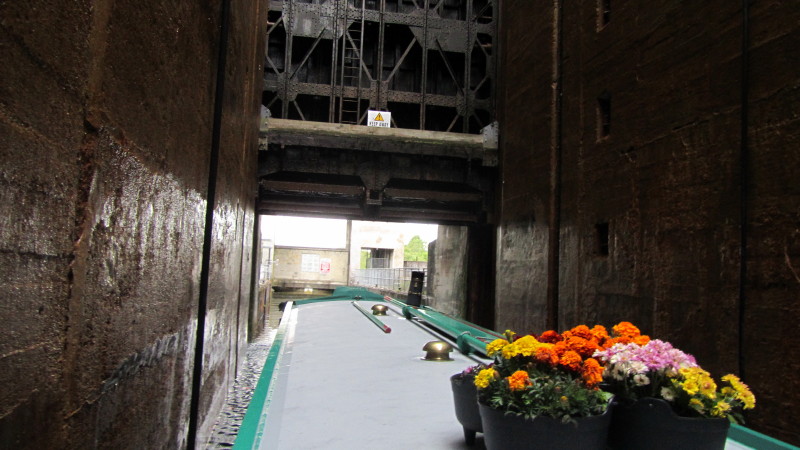
As we descend the upper chamber, the cill comes into view, and then rapidly rises up above our heads. We seem to go down forever!
The top gate cill is now far above us, as we continue our descent into the chamber of horrors!

On the middle gate, the wooden 'pallet' in front of us is there to protect the wall from over enthusiastic boats on their entry to the lock! The advised technique for holding the boat steady against the wall in the lock is to loop a rope round the metal pegs, from the centre of the boat. Once we start dropping down, Sally has to move the loop of rope from one hook to the next, standing in our centre doors. This worked very well on the descent.
The hooks come at regular intervals, though we do not know why this bottom one was offset.
Looking up from the bottom of the first part of the lock, the sky seems to have become smaller!
Having dropped 70' in the top chamber, we sail through into the lower one, where we will drop another 30'.

The middle gate closes behind us. Above the gate can be seen the curved wall which holds back the water in the top chamber.
As we descend, the closed gate appears above the cill and soon rises high above us.

The hooks in the lower chamber are similar to those in the upper, but the walls here are covered in moss.
The bottom gate now rises to allow us another drippy exit.
We had to go to the end of the lock channel, and out into the millrace to turn round for our return up the lock. There were two turbines running by then. As we turned we were whisked downstream sideways by the current and needed every ounce of our power to get back into the shelter of the lock cut.
It seemed strange to be going straight back up a lock. However, it had been made clear that this was quite acceptable. With relatively few boat passages per year, the lock keeper welcomes any business that comes his way. There isn't even a charge for this excellent service.
It was a relief to be back safely into the lower chamber of the lock. The middle lock gate can be seen, 30 feet above us.

When we were in the lower chamber, it was not possible to get a rope from the bows on to the rubber covered chains, as The Puzzler was an awkward length for these. This made it more difficult when the top gate was raised slightly to finish filling the lock, as Sally could not hold the boat on her rope. The bows went over and hit the left wall of the lock quite hard. There was no damage as the TV survived its jump on to the floor! Once this lock was full, there was a considerable delay. The middle gate would not go up, so engineers from Limerick were called out.

While we waited, Sally climbed the hundred steps up to the top of Ardnacrusha Dam, to chat to Ger, the lock keeper. He said that he hoped we were not planning on going out tonight as it might be a little while yet! There are plenty of railings to keep you safe up there. Andy and Catkin waited patiently on the boat. It was over an hour before the men arrived to fix the gate so that we could move on into the top chamber.

These views down into the top lock chamber were taken from the top of the dam. Do click on them to enlarge them, to get the full effect.
As soon as the gate was fixed we could move on into the top chamber of the lock. Still a long way to go up! We will rise another 70 feet, to make it 100 feet in all.
It was much easier in the top chamber, as the looped rope could also go round our front cleat.
Catkin, along with the rest of the crew, was very glad to have safely negotiated Ardnacrusha lock!
This fine Jacob's ram was on the bank by the headrace, as we made our way back upstream to Killaloe.
It had been an unforgettable experience!
The navigation arch of Killaloe Bridge is well protected; when the turbines at Ardnacrusha are running, there is quite a flow here.
Our first landmark is Parteen Weir, where we are expected at 10.30 am. The guillotine gate, or 'boat pass' is on the right hand side.
The guillotine gate has already been opened for us, and as we approach closer, we are on 'candid camera', so the barrier opens to let us pass. Once we are through, it closes silently behind us.
The headstream between Parteen Weir and the Power Station at Ardnacrusha is wide and straight. It is reminiscent of the Relief Channel, which runs from Denver Sluice to King's Lynn in Norfolk. There are no turbines on at Ardnacrusha this morning so it is very calm.
As we look under Blackwater Bridge, we can see Ardnacrusha Power Station looming up ahead of us. The lock is on the left of the structure.
The lock gate is open, ready for us.
As we descend the upper chamber, the cill comes into view, and then rapidly rises up above our heads. We seem to go down forever!
The top gate cill is now far above us, as we continue our descent into the chamber of horrors!
On the middle gate, the wooden 'pallet' in front of us is there to protect the wall from over enthusiastic boats on their entry to the lock! The advised technique for holding the boat steady against the wall in the lock is to loop a rope round the metal pegs, from the centre of the boat. Once we start dropping down, Sally has to move the loop of rope from one hook to the next, standing in our centre doors. This worked very well on the descent.
The hooks come at regular intervals, though we do not know why this bottom one was offset.
Looking up from the bottom of the first part of the lock, the sky seems to have become smaller!
Having dropped 70' in the top chamber, we sail through into the lower one, where we will drop another 30'.
The middle gate closes behind us. Above the gate can be seen the curved wall which holds back the water in the top chamber.
As we descend, the closed gate appears above the cill and soon rises high above us.
The hooks in the lower chamber are similar to those in the upper, but the walls here are covered in moss.
The bottom gate now rises to allow us another drippy exit.
We had to go to the end of the lock channel, and out into the millrace to turn round for our return up the lock. There were two turbines running by then. As we turned we were whisked downstream sideways by the current and needed every ounce of our power to get back into the shelter of the lock cut.
It seemed strange to be going straight back up a lock. However, it had been made clear that this was quite acceptable. With relatively few boat passages per year, the lock keeper welcomes any business that comes his way. There isn't even a charge for this excellent service.
It was a relief to be back safely into the lower chamber of the lock. The middle lock gate can be seen, 30 feet above us.
When we were in the lower chamber, it was not possible to get a rope from the bows on to the rubber covered chains, as The Puzzler was an awkward length for these. This made it more difficult when the top gate was raised slightly to finish filling the lock, as Sally could not hold the boat on her rope. The bows went over and hit the left wall of the lock quite hard. There was no damage as the TV survived its jump on to the floor! Once this lock was full, there was a considerable delay. The middle gate would not go up, so engineers from Limerick were called out.
While we waited, Sally climbed the hundred steps up to the top of Ardnacrusha Dam, to chat to Ger, the lock keeper. He said that he hoped we were not planning on going out tonight as it might be a little while yet! There are plenty of railings to keep you safe up there. Andy and Catkin waited patiently on the boat. It was over an hour before the men arrived to fix the gate so that we could move on into the top chamber.
These views down into the top lock chamber were taken from the top of the dam. Do click on them to enlarge them, to get the full effect.
As soon as the gate was fixed we could move on into the top chamber of the lock. Still a long way to go up! We will rise another 70 feet, to make it 100 feet in all.
It was much easier in the top chamber, as the looped rope could also go round our front cleat.
Catkin, along with the rest of the crew, was very glad to have safely negotiated Ardnacrusha lock!
This fine Jacob's ram was on the bank by the headrace, as we made our way back upstream to Killaloe.
It had been an unforgettable experience!
Thursday, 1 September 2011
Map of Ireland's Waterways. April - August
I am moving these maps of the Irish Waterways month by month to make it easier for you to follow our route through Ireland.
We started our journey near to Athlone, which is straight across Ireland from Dublin, on the River Shannon. We cruised from Athlone across Lough Ree, on up the River Shannon and across the Shannon - Erne Waterway to Upper Lough Erne. We sailed through Enniskillen and on to the far end of Lower Lough Erne at Belleek then back through Upper Lough Erne to Belturbet.
We sailed through Enniskillen and on to the far end of Lower Lough Erne at Belleek then back through Upper Lough Erne to Belturbet. Next it was back along the Shannon - Erne Waterway. We sailed up Lough Key to Boyle, then back to the River Shannon. We followed the Shannon back to Lough Ree, and on to Lough Derg, the largest and most impressive of the loughs on the Shannon. We reached Killaloe late in August, and continued on to go through Ardnacrusha Lock.We considered Limerick a step too far.
We started our journey near to Athlone, which is straight across Ireland from Dublin, on the River Shannon. We cruised from Athlone across Lough Ree, on up the River Shannon and across the Shannon - Erne Waterway to Upper Lough Erne. We sailed through Enniskillen and on to the far end of Lower Lough Erne at Belleek then back through Upper Lough Erne to Belturbet.
We sailed through Enniskillen and on to the far end of Lower Lough Erne at Belleek then back through Upper Lough Erne to Belturbet. Next it was back along the Shannon - Erne Waterway. We sailed up Lough Key to Boyle, then back to the River Shannon. We followed the Shannon back to Lough Ree, and on to Lough Derg, the largest and most impressive of the loughs on the Shannon. We reached Killaloe late in August, and continued on to go through Ardnacrusha Lock.We considered Limerick a step too far.
Wednesday, 24 August 2011
20th - 24th August. Scarriff River, then Lough Derg to Killaloe
Once the wind died down, we set off westwards on Lough Derg. As usual here, the clouds are quite spectacular. The west end of Lough Derg becomes Scarriff Bay, and leads to the Scarriff River.
On leaving the lough, it is like entering a different world. Reeds line both sides of the river here, and the water is so still.
Reddan's Quay is a small mooring further back on the Scarriff River. Mini Puzzle had been towed behind The Puzzler, but we stopped here to deflate it, ready for our long sail down to the south of Lough Derg. We had planned to stay here overnight, but as the weather was so calm, we carried on. Lough Derg is much more comfortable in calm conditions.
At the bottom end of Lough Derg, there is a new jetty at Killaloe, which only opened in June this year. There are lots of water and electric points right along the jetty.
Killaloe, on the right bank of the Shannon River, is a surprisingly hilly town. St. Flannan's Cathedral is situated near to the river and is an impressive building.It was built in the 13th Century, but with a new tower added in 1800.
We found a good walk up the hill above the moorings.
Killaloe canal can be seen to the right of the Shannon, with the new jetty to its left. Killaloe bridge is beyond the new jetty, with Ballina village on the far bank, underneath the rainbow.
Killaloe canal was originally built to bypass a former weir. When Ardnacrusha Dam was built, it raised the water levels, and the canal lock has been removed, as there is no longer a weir. However the canal is currently not passable, due to this gate, which prevents the full force of the river from causing erosion by flowing down the canal. Catkin is wearing her boots to protect her feet from the rough surfaces which abound on walkways and paths.
The road on the bridge at Killaloe is very narrow, and is controlled by traffic lights, to the annoyance of busy traffic. From the river though, the bridge is very attractive. There is room to moor a few boats above the bridge in Ballina.
We were lucky to see these swans flying down the River Shannon past The Puzzler.
Subscribe to:
Posts (Atom)